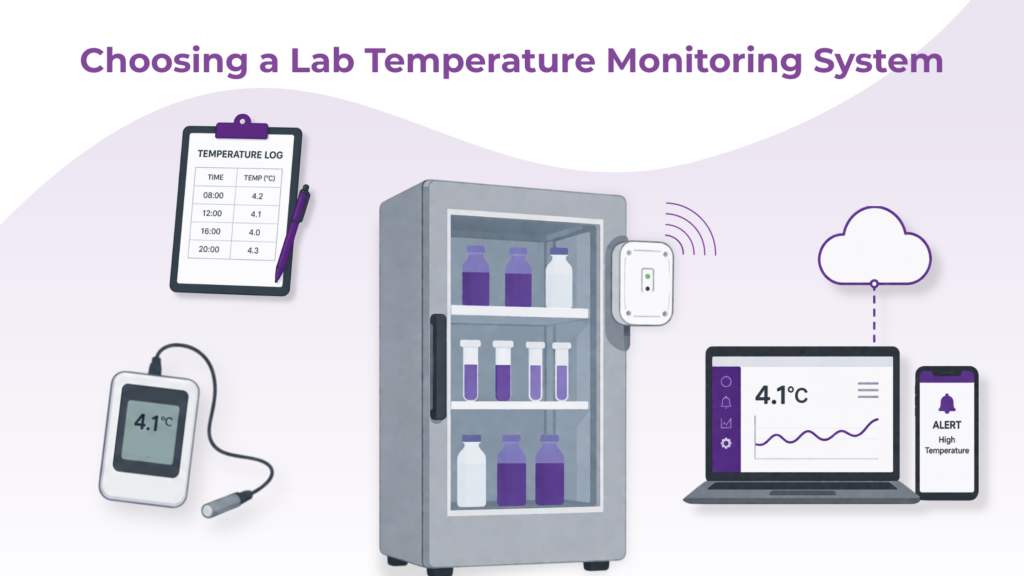
Choosing the right lab temperature monitoring system isn’t just about tracking temperatures; it’s about protecting sample integrity, maintaining compliance, and avoiding preventable risk.
From lab fridge monitoring in a single site to managing a full laboratory temperature monitoring system across multiple locations, the expectations placed on labs have changed significantly.
Manual processes and legacy systems that once felt “good enough” are now creating visibility gaps, and those gaps can lead to missed excursions, failed audits, or compromised results.
As ISO 15189 requirements tighten and audit expectations increase, temperature monitoring has become a critical part of demonstrating control.
Why Laboratory Temperature Monitoring Matters More Than Ever
Up to 70% of laboratory errors occur in the pre-analytical phase, where handling and storage conditions play a key role.*
This makes laboratory fridge temperature monitoring and medical fridge monitoring critical to both operational performance and patient outcomes.
When temperatures drift outside acceptable ranges, the impact isn’t always immediate, but it can be significant:
- Sample integrity can be compromised
- Recollection may be required
- Turnaround times are affected
- Confidence in the results is reduced
This is why modern labs are moving away from periodic checks toward continuous, real-time monitoring.
Common Approaches to Lab Temperature Monitoring
There are still a range of approaches used for lab fridge temperature monitoring today, but they vary significantly in reliability and control.
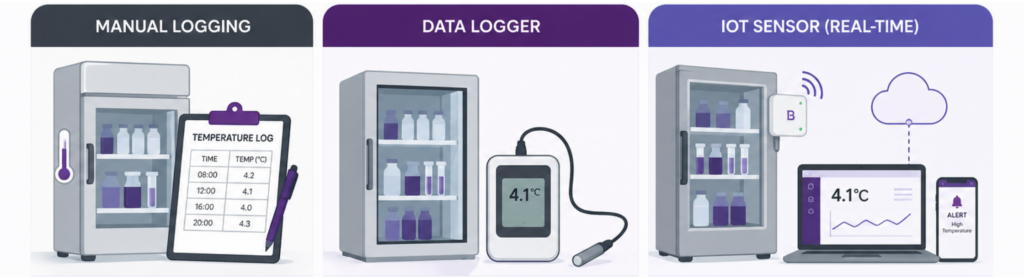
Manual Logging
Paper-based or spreadsheet tracking at set intervals.
Where it falls short:
- Easy to miss excursions between checks
- Time-consuming and inconsistent
- Difficult to demonstrate during audits
Data Loggers
Used widely for laboratory fridge temperature monitoring, where data is downloaded periodically.
Where it falls short:
- No real-time visibility
- Issues are only discovered after they’ve occurred
- Limited ability to act quickly
Connected Monitoring Systems
Modern laboratory temperature monitoring systems that stream data in real time to a central platform.
Why they’re becoming the standard:
- Continuous monitoring with no gaps
- Immediate alerts for temperature deviations
- Automated, audit-ready reporting
- Scalable across sites and regions
This shift from retrospective data to real-time visibility is one of the biggest changes in lab operations.
What to Look for in a Lab Temperature Monitoring System
Not all systems are designed with compliance and usability in mind. When evaluating a lab temperature monitoring system, these features make the biggest difference:
Real-Time Alerts: Essential for medical fridge temperature monitoring, ensuring teams are notified immediately when temperatures fall outside acceptable ranges.
Continuous Monitoring: Especially important in pathology fridge temperature monitoring, where even small gaps in data can create compliance risks.
Audit-Ready Reporting: Reports should align with ISO 15189 and be easy to access during audits.
Remote Access: Teams should be able to monitor lab fridge temperatures and historical data from anywhere.
Minimal Infrastructure: Many medical fridge monitoring systems rely on Wi-Fi, gateways, or IT support, adding complexity and cost.
Scalability: A good system should grow with you, from a single fridge to a national network of laboratories.

Common Pitfalls in Laboratory Temperature Monitoring Systems
Even systems that appear similar can introduce hidden challenges.
“Real-Time” That Isn’t Real-Time: Some systems only batch-upload data, delaying alerts and reducing effectiveness.
Hidden Infrastructure Costs: Additional hardware like gateways and routers can significantly increase total cost.
Complex Installation: Long or technical deployments slow down adoption and create internal friction.
Limited Data Accessibility: If reports aren’t easily accessible, audits become more difficult and stressful.
Alert Fatigue: Too many unnecessary alerts can reduce responsiveness.
ISO 15189 and Lab Temperature Monitoring
A compliant lab temperature monitoring system must do more than record data, it must demonstrate control.
This is particularly important for:
- Laboratory fridge temperature monitoring
- Medical fridge temperature monitoring
- Pathology fridge temperature monitoring
To support ISO 15189, a system should provide:
- Continuous, uninterrupted temperature logs
- Timestamped records for full traceability
- Immediate alerts for deviations
- Clear documentation of corrective actions
- Easy access to historical data
Without these, audit readiness becomes significantly more difficult.
Evaluation Checklist for Lab Temperature Monitoring Systems
If you’re comparing solutions, these are the questions worth asking:
- Does the system provide real-time alerts?
- Can data be accessed remotely?
- Are reports automatically generated?
- Does it require Wi-Fi or additional infrastructure?
- How long does installation take?
- Can it scale across multiple sites?
- Does it support compliance requirements?
- Are alerts configurable?
- Is historical data easy to retrieve?
- What ongoing maintenance is required?
Final Thoughts
A lab temperature monitoring system should do more than record data, it should give you confidence.
Confidence that:
- You’ll be alerted when something goes wrong
- You can access the data you need, when you need it
- Your processes will stand up under audit
Whether you’re focused on lab fridge monitoring, medical fridge monitoring, or a broader laboratory temperature monitoring system, the right approach simplifies operations while strengthening compliance.
FAQ: Lab Temperature Monitoring Systems
What is a lab temperature monitoring system?
A lab temperature monitoring system is a solution used to continuously track and record temperature conditions in laboratory equipment such as fridges and freezers. Modern systems provide real-time alerts, remote access, and audit-ready reporting.
Why is lab fridge temperature monitoring important?
Lab fridge temperature monitoring ensures that samples are stored within required temperature ranges. Deviations can compromise sample integrity, affect results, and lead to compliance issues.
What is the difference between data loggers and real-time monitoring systems?
Data loggers record temperature data that must be downloaded manually, meaning issues are only identified after they occur. Real-time monitoring systems provide continuous visibility and instant alerts, allowing immediate action.
Do lab temperature monitoring systems need Wi-Fi?
Not always. Some modern systems use direct-to-cloud connectivity and do not require Wi-Fi or additional infrastructure, reducing complexity and setup time.
How does temperature monitoring support ISO 15189 compliance?
ISO 15189 requires labs to demonstrate control over storage conditions. A temperature monitoring system supports this by providing continuous logs, traceable records, real-time alerts, and accessible audit documentation.
What should I look for in a laboratory temperature monitoring system?
Key features include real-time alerts, continuous monitoring, audit-ready reporting, remote access, minimal infrastructure requirements, and scalability across multiple sites.
If you’re reviewing your current approach to lab fridge temperature monitoring, it’s worth asking whether your system is helping you stay in control or just capturing data after the fact.
Book a demo with BinaryMed or email us at [email protected] to see how real-time monitoring can provide continuous visibility, automated reporting, and stronger audit readiness.
*Plebani M. Errors in clinical laboratories or errors in laboratory medicine? Clin Chem Lab Med. 2006;44(6):750-759.